

Your Blueprint for High-Volume OEM Success.
Rolling Paper Sizes: Complete Guide to 1¼, 1½, King Size and King Size Slim
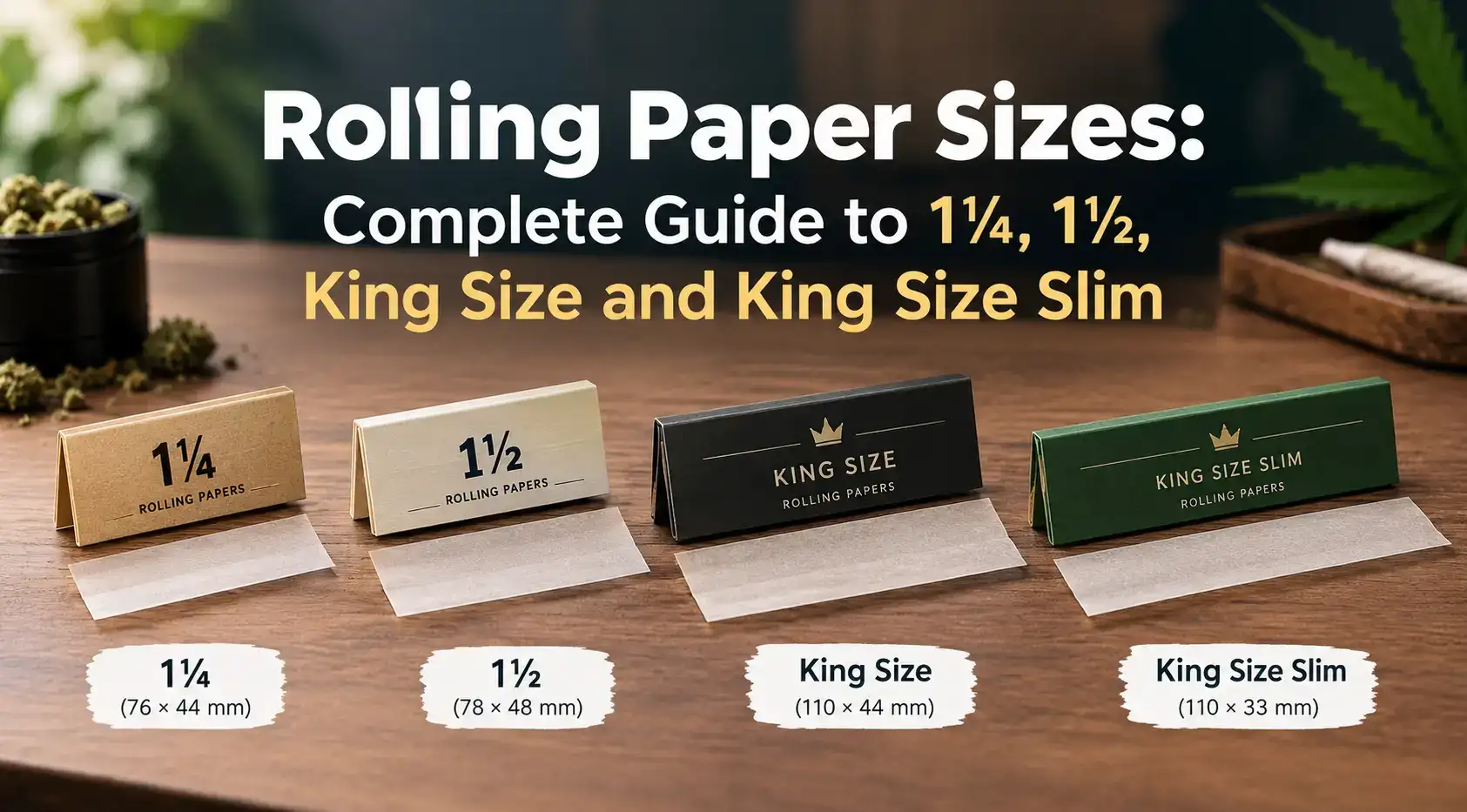
The most popular rolling paper size is 1 1/4 rolling paper which measures approximately 76–78 mm long and 44–48 mm wide. In the cigarette-making market this paper is a common all-purpose standard for everyday rolling. It offers a practical balance between paper coverage, available space, and ease of handling. Other sizes, including Single Wide, 1 1/2, King Size, King Size Slim, and continuous rolls, serve different preferences and purposes.
But size is about more than length. The paper you choose affects the paper-to-herb ratio, burn consistency, and overall smoking experience. A paper that is too wide for the amount of material can leave excess paper in the roll. A narrow sheet, on the other hand, gives you less room to tuck and shape the contents.
That is why choosing the right rolling paper size is crucial for production efficiency. Experienced rolling professionals understand the importance of the difference between various rolling paper sizes you are new to rolling or already familiar with different paper formats, understanding the differences helps you make a more informed choice.
Complete Rolling Paper Size Chart
The following table compares common rolling paper sizes by their properties.
|
Paper Name |
Standard Dimensions (L × W) |
Herb Capacity (Approx.) |
Best For |
Rolling Difficulty |
|
Single Wide |
~68–70 mm × 34–36 mm |
0.3 – 0.5 g |
Quick solo sessions |
Advanced |
|
1 1/4 (Standard) |
~76–78 mm × 44–48 mm |
0.5 – 0.8 g |
Everyday rolling, 1–2 people |
Beginner |
|
1 1/2 |
~76–78 mm × 60–62 mm |
0.9 – 1.2 g |
Thicker rolls, shared sessions |
Intermediate |
|
King Size |
~100–110 mm × 53–60 mm |
1.0 – 1.5 g |
Large groups, party cones |
Intermediate |
|
King Size Slim |
~105–110 mm × 42–46 mm |
0.8 – 1.2 g |
Slow, clean burn with less paper |
Intermediate/Advanced |
|
Rolls (Continuous) |
Custom length × ~44–54 mm |
Custom |
Artistic rolls, custom lengths |
Advanced |
Single Wide: The Compact Option
Single Wide papers measure around 68–70 mm long and 34–36 mm wide. Their smaller surface area makes them a compact option when you do not need a larger sheet.
The downside of using a single-wide is control. With less width available, there is less room to shape and tuck the paper around the contents. Beginners will find rolling difficult to do accurately especially when trying to maintain an even shape.
That means a smaller paper is not automatically an easier paper to roll. Single Wide is suitable for experienced rollers who prefer a compact format. However, the narrower width means there is not much room to make any rolling mistakes.
1 1/4: The General Standard
The 1 1/4 format, popularly called the Spanish size, is a widely used option. It strikes the right balance between length and width. At approximately 76–78 mm long and 44–48 mm wide, it provides more working space than Single Wide without becoming unnecessarily large.
The additional width gives you more room to shape the paper and tuck in a precise and neat manner. This makes the format approachable for beginners. It is also really practical for experienced users.
This particular size is also commonly compatible with standard 79 mm rolling machines. If you plan on using a rolling machine make sure to confirm the machine's specifications before you move forward.
Why does this size stand out?
The Spanish size avoids the extremes of a narrow sheet and a larger, wider format. For many rolling paper buyers, that balance makes 1 1/4 a sensible starting point if they are inexperienced with rolling since this size is easier to work with.
1 1/2: The Wider Format
The 1 1/2 format generally shares a similar length with 1 1/4 papers but has a significantly larger width. The 1 1/2 sheet measures around 76–78 mm long and 60–62 mm wide.
That additional surface area gives you more space for a wider roll.The added surface area allows for a larger volume of material to be rolled without requiring the same degree of compression into a narrower shape.
However, more width does not guarantee a better result. Several factors like proper paper handling, material distribution, and the amount of unused paper affect performance.
As a roller, consider 1 1/2 when a wider width of the rolled product is the main requirement.
King Size vs. King Size Slim: What Is the Difference?
King Size and King Size Slim papers are both designed around a longer format, but their widths differ.
A standard King Size sheet commonly measures 100–110 mm long and 53–60 mm wide. King Size Slim is usually around 105–110 mm long and 42–46 mm wide.
The difference is important. King Size Slim provides a longer sheet with less width, while standard King Size offers more surface area across the roll.
A narrower sheet reduces the amount of paper used in the overlap. That helps in limiting excess paper taste so that it does not influence the real flavor of the material.
This happens because size alone does not determine how much paper ends up in the finished roll. A well-matched sheet matters more than choosing the largest available option.
Continuous Rolls: Flexible Lengths for Different Preferences
Continuous rolling paper rolls, often called paper rolls or spools, lets the manufacturer choose the length rather than working with a fixed sheet.
The width is usually consistent along the roll, while the length can be adjusted to product type and specification. This conveneint design of a continous roll offer flexibility for producers who want a custom rolling format.
However, custom sized rolls should only be made by experiened people as multiple other aspects need to be considered.
The main advantage of a continous roll is its flexibility in making rolls of variable length. The trade-off is the the roller manufacturer needs to have more expertise since they are not as easy to roll as pre-cut papers.
Decision Matrix: How to Choose the Right Size
The most practical and easy way to compare rolling paper sizes is to start with your requirements. Once you are clear on that, consider your rolling experience and the paper's dimensions.
Choose by Intended Session Size
Different sizes offer different amounts of surface area. A compact sheet is sufficient for a smaller roll size. Longer or wider formats provide more space for more tobacco or herb material.
Single Wide and 1 1/4 come in the compact segment. The wider 1 1/2 format offers more width, while King Size and King Size Slim provide additional length.
Remember that paper capacity is not a fixed volume measurement. The amount that fits depends on the type of material density also. A denser herb or large tobacco particles means that lesser amount would fit.
Choose by Rolling Experience
If you are a beginner-level roller, 1 1/4 is a practical format to learn about first. Its width provides more room for handling than Single Wide allowing for easier rolling experience.
Experienced rollers can go with narrower or longer formats because they are familiar with the skill these dimensions require. But one thing to keep in mind is that no matter how experienced someone is the first thing they should consider before even beginnning the rolling process is matching the sheet to the intended dimensions.
A paper should fit the task. It should not make the task unnecessarily complicated.
Consider Grind Consistency
Material consistency also affects how easily the contents can be distributed within a paper.
Coarser material can be more difficult to arrange evenly in a narrow space. A wider format offers more room for placement, although paper width alone cannot correct inconsistent preparation.
Finer material may be easier to distribute across a narrower sheet. Even so, the final result depends on the material itself and how it is handled.
That is why paper selection and material consistency should be considered together, rather than treating paper size as the only factor that influences the result.
Expert Rolling and Sizing Tips
Account for Filter and Crutch Dimensions
Filters and crutches take up part of the available length of a standard roll. Some ceramic and glass tips take approximately 20–25 mm of space. So making a filter the part of a roll will naturally result in less space for material.
This matters when comparing paper formats. A rolling sheet will seem to have long enough measurements in the spec document but in practical terms it will offer less usable space once the filter is inserted in it.
King Size Slim papers are often considered a suitable format for cigarette rolls that have a glass tip. Still, check the dimensions of both components rather than relying on the size name alone.
Understand the Backroll Method
A backroll, sometimes called a Dutch roll, is a technique intended to reduce excess paper in the finished roll. The general idea is to manage the paper overlap so that less unused paper remains.
Wider sheets, including 1 1/2 and King Size formats, provide more surface area to work with. However, the technique requires practice, and the paper dimensions do not guarantee a particular result.
The practical lesson is straightforward: more paper is not always better. Choosing a suitable size can help avoid unnecessary overlap in the first place.
Avoid Using More Paper Than You Need
A common sizing mistake is choosing a large sheet for a relatively small amount of material. The finished roll may then contain more paper than necessary.
Excess paper can affect the paper-to-herb ratio and contribute to an uneven burn. In some cases, inconsistent burning can lead to canoeing, where one side burns faster than the other.
But paper size is only one possible factor. Moisture, distribution, construction, and paper quality can also affect burn consistency.
So, rather than assuming a larger sheet offers greater flexibility in every situation, compare the paper dimensions with the intended roll size. A suitable fit can reduce unnecessary paper and help avoid avoidable handling problems.
Conclusion
If you are choosing the right rolling paper size the most important thing is dimensions which suit your intended format without adding unnecessary paper or making handling more difficult.
Use these general rules when comparing options:
Single Wide: A compact format with limited working space.
1 ¼. A balanced, widely used standard for everyday needs.
1 ½. A wider format when additional width matters.
King Size. A longer sheet with more width.
King Size Slim. A longer, narrower alternative.
Continuous Rolls. A flexible option when a custom length is important.
Ultimately, informed selection comes down to fit. When you understand how length, width, and paper characteristics work together, you can compare available options more confidently.
Recent Posts

 by Admin


Categories

Gallery


Moon

Have a question or need a quote? Fill out this form and our team will get back to you quickly!