

Your Blueprint for High-Volume OEM Success.
What Are Rolling Paper Watermarks and Why Are They Used?
Highlights
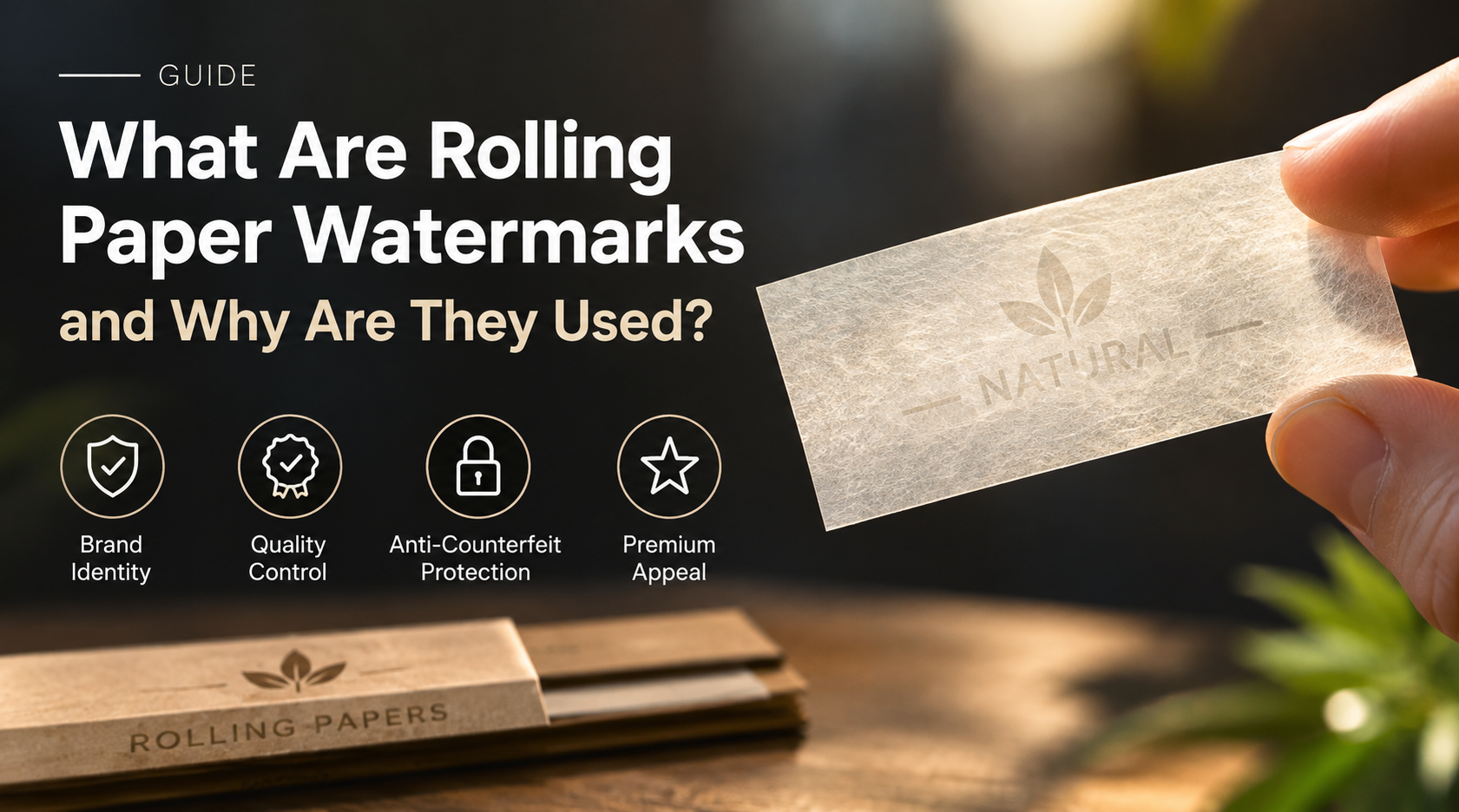
· A rolling paper watermark is a fine print rolled into the paper while it is still damp. You can see it by shining light through it.
· A dandy roll makes it. Most papers rolled are 12 to 20 gsm, so the mark has to be shallow.
· Brand watermarks are used to identify, regulate, and protect against fake brands.
· A custom watermark demands tooling plus typically a minimum of 500 kg (or more).
If you hold a rolled-up piece of paper up to the light and a faint logo or line pattern shows, then you were successful. This mark is a watermark. It was done while the paper is still wet, before it is printed or cut. Brands use them to show who made the paper, its authenticity, and quality. Through this guide, you will learn how watermarks are created, what they are for, and what you should ask a rolling paper manufacturer before ordering.
What Are Rolling Paper Watermarks?
A watermark is a translucent type of design or image that appears on the paper during printing to make it more transparent or visible. It appears lighter when seen in daylight. It is not printed ink. It is a part of the paper, and this paper is difficult to duplicate.
A Short History of Watermarks in Paper
Watermarks are older than any rolling version of paper. In Italy, Fabriano began adding wire designs to identify makers and paper grades around 1282. The concept was later adopted for security in banknotes and in legal documents. This method was adopted for rolling papers as it is cheap and permanent. In the 1820s, the dandy roll enabled continuous watermarking on machine-made paper. A wire-covered cylinder rides on the wet web. Modern mills still use it. The same mark is repeated thousands of times on a long strip of thin paper to produce an identical booklet signature.
How Are Watermarks Made in Rolling Papers?
A dandy roll rolls a pattern or emboss cylinder onto the wet paper web. The pressure softens these fibers at that location. The thin area allows light to pass through, and that's the visible mark.
Dandy Roll and Shadow Methods
Two methods dominate. A wire watermark combines a raised pattern of fine wire on the roll. It can form lines and logos, and it is the regular preference for rolling papers. A shadow watermark can be created with an embossed roll to create smooth gradations of light and dark. It requires additional detail and is more expensive to tool. Thin paper limits the design. The pattern will be shallow because rolling papers are typically between 12-20 gsm. If a deep mark were made, it would leave behind weak spots or small holes. Mills keep relief low and patterns minimal. That is a reason for most rolling paper watermarks being small logos, some wave patterns, or brand names repeated along the paper.
Main Reasons Brands Use Watermarks
· Brand identity comes first. A watermark is a mark made by the printer within the paper, in an area that cannot be printed. Smokers who are looking for a familiar pattern know they are getting what they requested. It's similar to using a signature. The printed packaging is easy to replicate, while a pattern in the fiber is much more difficult.
· The second is a reason for quality control. A clean, even watermark is used to indicate that the web was formed correctly. When you see streaks, breaks, or faded areas, it indicates a machine that has uneven fibers or pressure issues. Mills compare the sharpness of watermarks to reference sheets. Buyers can repeat the test using a lamp and a booklet.
· The marketing role is also relevant. A visible mark adds that premium quality to hemp, rice, and unbleached papers. Some brands use a watermark that's visible along the gum line or the edge; it is revealed with each roll. It's inexpensive per booklet and gives a little edge in a crowded bookstore.
Watermarks and Burn Performance
Watermarking has minor effects on burn. The marked area is slightly thicker or thinner, but that is not that significant. Burning rate is mainly affected by fiber type, basis weight, filler, and porosity. Different kinds of wood pulp, flax, hemp, or rice will burn differently. Calcium carbonate filler and additives further modify the speed. Porosity is expressed in CORESTA units; many rolls vary as much as from approximately 10 to 100 units. Higher numbers mean higher flow and a faster burn rate. Some of these settings may be modified for different products by a mill. Gum is typically applied in the form of a narrow strip and is usually acacia. These settings are not related to the watermark setting.
Spotting Fake Rolling Papers by Watermark
Check the watermark before buying. Bring the paper up to a lamp and take a look at it with a known true sample. A real watermark will appear as lighter paper, with soft edges on each leaf. They fake it using a printed, light textured pattern. The pattern is present on the top layer and will show through in any lighting conditions. Check out the specifics as well. The counterfeiting spacing is uneven and/or logos are irregularly blurred or inconsistent between booklets. Check print registration on packaging, print quality on the gum line, and on the barcode. Also, the weight is not quite right. Authentic papers are uniform throughout the booklets. If ordering bulk mill, order samples from all lots and compare against a reference sample.
Can Watermarks Be Customized for Private Label Rolling Papers?
Yes. A mill can make a custom watermark by building a new dandy roll or wire cover. Tooling costs $5,000, and packaged runs usually start at 500 kg and have an 8- 12-week lead time.
Specs Buyers Should Compare
Watermarks are one item on a long spec sheet. Compare size first. Common formats: single wide (about 70 mm), 1 1/4 (78 mm), and king size (108–110 mm). Booklets usually contain 32 or 50 leaves. The basis weight is usually between 12 and 18 gsm for thin papers.
Next on the list are material and cost. Questions about paper made from wood pulp, flax, hemp, or rice. Look at the gum type and the kind of ink used for the printing. The price of a private label booklet varies by material and print and ranges from USD 0.08 per piece, depending on quantity and volume. The higher the cost, the thinner the sheet, the more customized the watermark, or the better the packaging.
Choosing a Rolling Paper Manufacturer
A good paper manufacturer shares data; they don't chase it. Request ISO 9001 certification and receive a recent audit report. If the pulp is certified, request the FSC documents. Discuss validity of basis weight, porosity, and watermark clarity quality checks. Verify paper and ink comply with rules for the target market. Try to order samples before making a large purchase. Ask for 5-10 booklets from the same lot, and light test burn, roll, and watermark. Stock items are typically shipped in 4-8 weeks. Custom work requires 8 – 12 weeks. Before production starts, confirm the defect terms, lot, and payment terms in writing.
Conclusion
A watermark on a rolling paper is a small mark that has a very specific function. It specifies the manufacturer of the paper, confirms authenticity, and indicates that the mill was supervising the paper-making process. It also gives some space to the private-label brands. Check the watermark and review the entire datasheet before ordering in large quantities, and check samples, certificates, and tooling terms from the manufacturer before ordering.
FAQs
What is the best place to get rolling papers in bulk to sell?
Purchase from a distributor of rolling paper, stock sizes 1 1/4 and king size, packaging ready and prepared for retail.
What is the wholesale price of rolling papers?
Typical wholesale rates are USD 0.08 – USD 0.30 per booklet, which vary with material, size, and order size.
Who provides bulk and custom rolling papers from a single provider?
Choose a mill with stock lines and private label, so you pay one company for both.
Do watermarks affect how rolling papers burn?
Only slightly. The watermark burns much smaller than the fit, basis weight, filler, and porosity.
Recent Posts

 by Admin
Categories

Gallery


Moon

Have a question or need a quote? Fill out this form and our team will get back to you quickly!